This is where I've seen the biggest impact. Generating meaningful test data used to mean manual work or writing complex scripts. Now, AI models trained on your real data can generate scenarios that:
One team we worked with cut their test data prep time from 3 days to 3 hours. That freed up the senior QA engineer to focus on test strategy instead of data spreadsheets.
Not all test failures are equal. A flaky network timeout is different from a logic bug. An AI-powered system can:
This means your team stops drowning in false positives and focuses on real problems.
AI excels at pattern recognition. This makes it surprisingly effective for:
The key: AI handles the repetitive pattern-matching while your team writes the quality heuristics.
Here's where teams often stumble:
AI doesn't replace test strategy. You still need someone thinking about what matters. AI can generate 10,000 test cases; you need judgment to figure out which 100 actually matter.
AI doesn't fix broken processes. If your testing is chaotic now, AI will automate chaos. Get your fundamentals right first.
AI doesn't understand business context the way humans do. "This feature must never fail on Black Friday" is context that AI learns from, but your domain expertise decides it.
Let's be honest: implementing AI in QA requires investment:
But the payoff tends to show up in:
One team reported that AI-powered visual testing reduced regression bugs by 73% in their redesign phase. Another cut their API test suite maintenance overhead in half.
Start small. Don't try to AI-ify your entire test suite on day one. Pick one painful area:
Measure before and after. How many hours do you spend on this problem now? How much would it cost to solve manually next year? That's your baseline.
Keep humans in the loop. The best AI implementations we've seen involve AI making the first pass and engineers making the final call. This isn't "set it and forget it" technology yet.
Choose your tool based on your pain, not the hype. There's a massive difference between a statistical test analyzer and a full ML-powered testing platform. Match the solution to your actual problem.
AI in QA works best when teams already have decent testing fundamentals. If you don't have:
Then AI will amplify those problems before it solves them.
The teams seeing the biggest wins are ones that treated AI as the final piece of a mature testing strategy, not the first step.
We're already seeing:
The next 12 months will be interesting. The hype cycle is still in full swing, but teams with realistic expectations and solid implementation plans are pulling ahead.
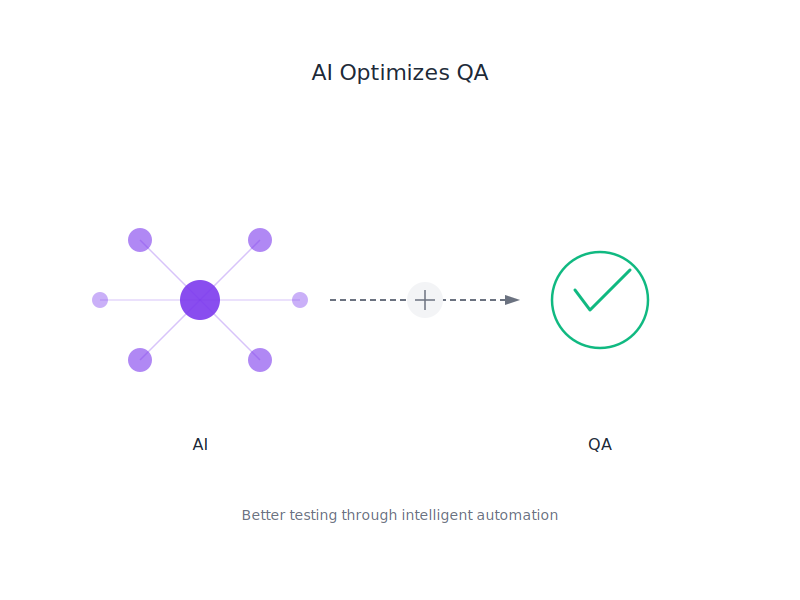
AI in QA isn't about replacing engineers. It's about giving them better tools for the work that actually matters. The teams winning with AI aren't the ones trying to automate everything. They're the ones smart enough to automate what's repetitive and keep humans in charge of what's important.
Your team's expertise in finding bugs, understanding user needs, and thinking strategically? That's not going away. That's becoming more valuable.
Want us to catch bugs like these before your customers do? Get a free mini-audit or see our services.